← Back to Courses
About this course
### Cybersecurity & Ethical Hacking – Professional Course
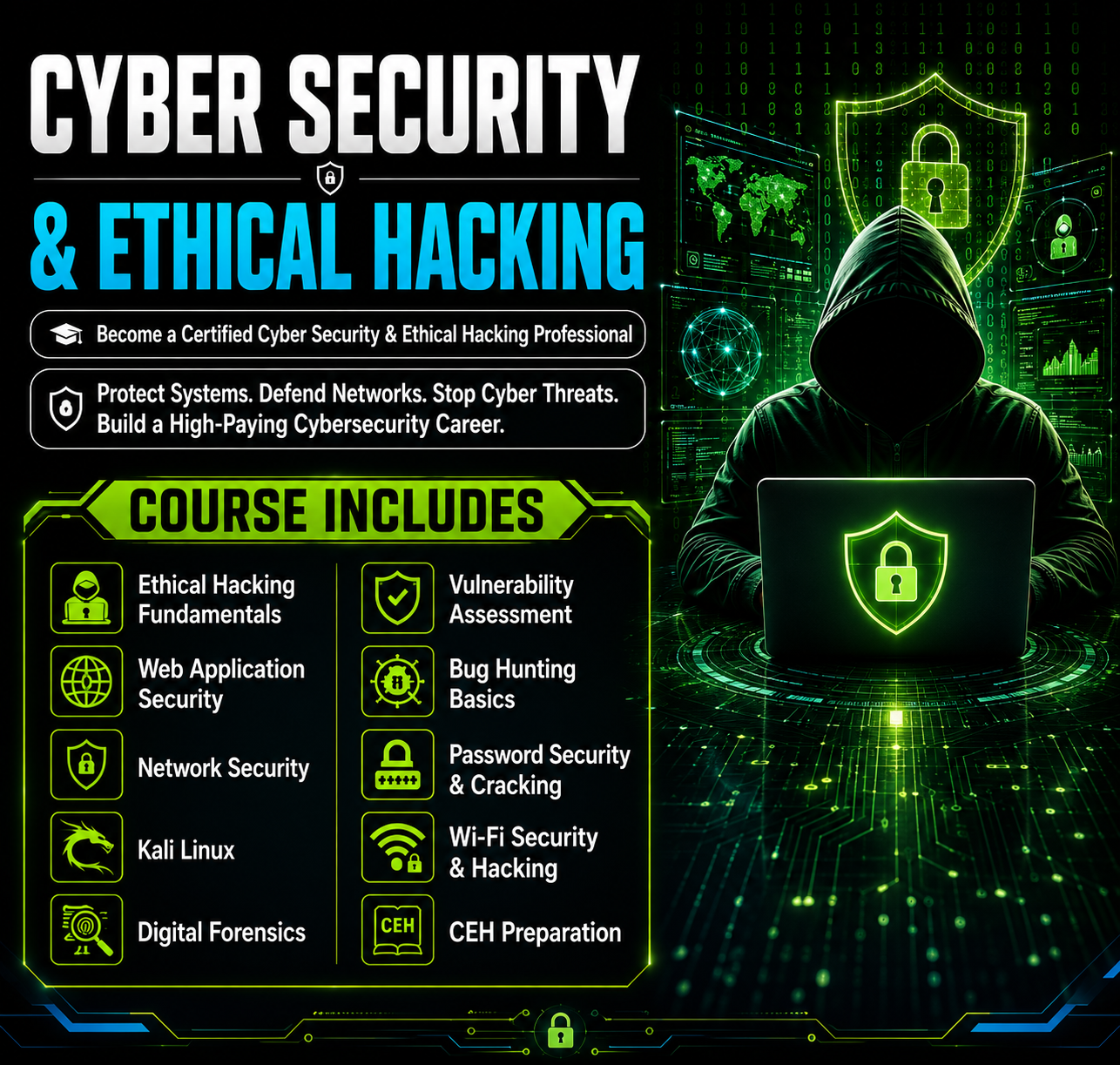
Master the essential skills of Cybersecurity and Ethical Hacking through a comprehensive **4-month, hands-on training program** designed to take you from beginner to advanced level. This course covers cybersecurity fundamentals, networking, Linux and Windows security, cryptography, vulnerability assessment, web application security, penetration testing, phishing awareness, social engineering, Wi-Fi security, and ethical hacking methodologies. You will gain practical experience with industry-relevant tools such as **Kali Linux, Wireshark, Nmap, Burp Suite, Metasploit, Nessus/OpenVAS, Aircrack-ng, OpenSSL, and TryHackMe/HackTheBox** through controlled lab environments. The program also includes a dedicated **1-month Capstone Project**, where you apply your skills to a complete security project, document your findings, prepare a professional security report, and present your work. By the end of the course, you will have practical cybersecurity knowledge, hands-on experience, and a portfolio-ready project to support your career or further professional certifications such as **CompTIA Security+, CEH, or OSCP**.
Course Outline
Structured module-wise outline with topics and duration.
22 Items
| Module | Topics | Duration |
|---|---|---|
|
4
|
Cryptography & Security Principles
● Symmetric vs asymmetric encryption, hashing, digital signatures
● SSL/TLS and how HTTPS secures the web
● Authentication, authorization & access control models (MFA, RBAC)
● Month 1 recap quiz and knowledge checkpoint
Hands-on Lab: Use OpenSSL to generate keys, encrypt files, and verify hashes (MD5/SHA256).
|
—
|
|
5
|
Network Security
● Firewalls, IDS/IPS, VPNs, and network segmentation
● Common network attacks: MITM, ARP spoofing, DoS/DDoS
● Secure network architecture design principles
Hands-on Lab: Configure a basic firewall (iptables/pfSense) and simulate an ARP spoofing attack in a lab.
|
—
|
|
6
|
System & Endpoint Security
● Malware types: viruses, worms, trojans, ransomware, spyware
● Antivirus/EDR concepts, patch management, hardening checklists
● Introduction to malware analysis (static vs dynamic)
Hands-on Lab: Analyze a sample malware behavior report in a sandboxed environment (e.g., Any.Run/Cuckoo).
|
—
|